1. Basic Idea of Continuous Wavelet Transform
The Continuous Wavelet Transform (CWT) is a time–frequency analysis method designed for non-stationary signals. Unlike the Fourier transform, which only provides global frequency information, CWT can describe how the frequency content of a signal evolves over time.
The core idea is to use a localized oscillatory function, called the mother wavelet, and compare it with the signal at different time positions and scales. By stretching (scaling) and shifting the wavelet, we can analyze the similarity between the signal and the wavelet at different time–frequency regions. When the wavelet matches the local structure of the signal, the corresponding wavelet coefficient becomes large.
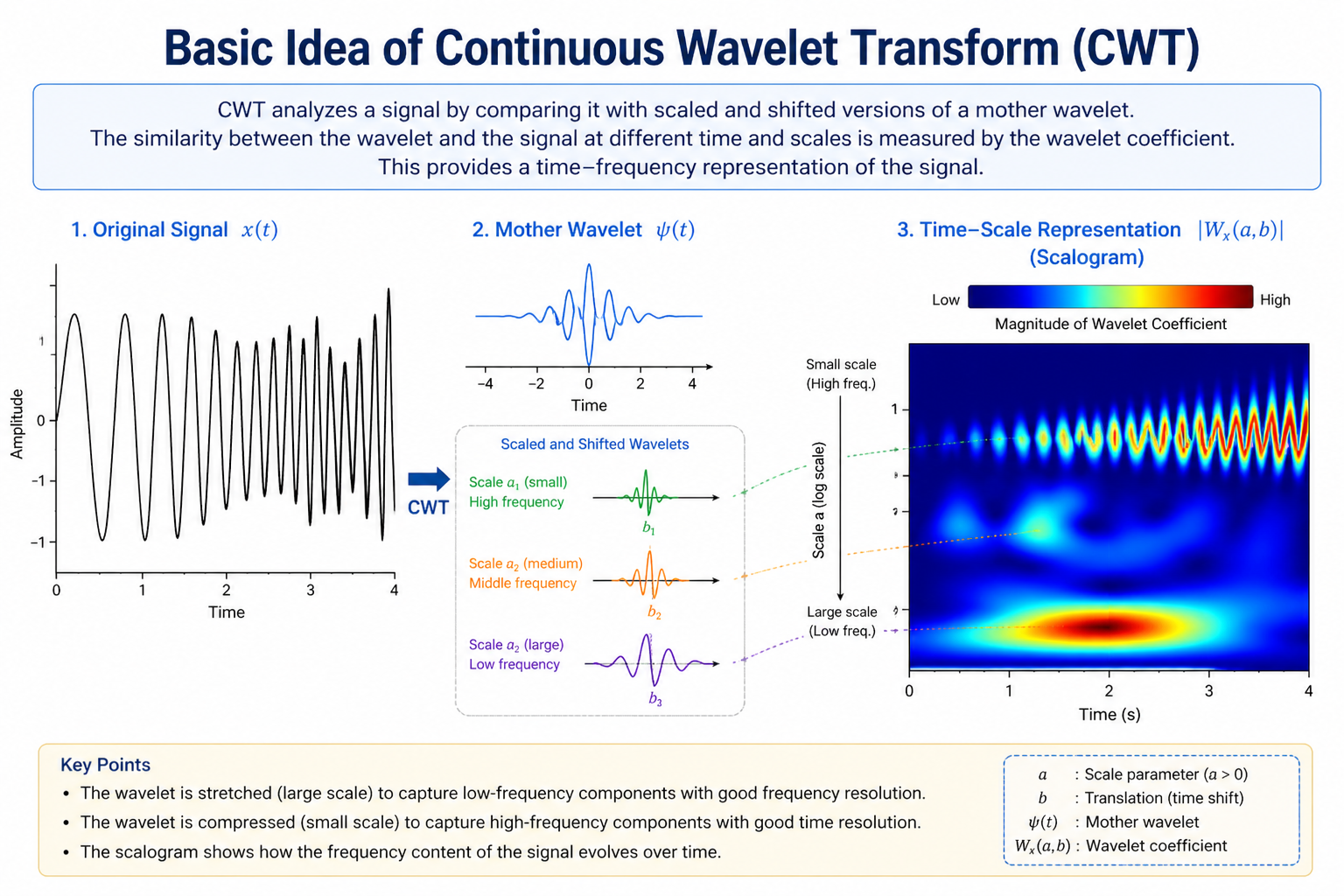
Thus, CWT can be understood as a variable-window analysis method. For high-frequency components, a narrow time window is used, providing high time resolution. For low-frequency components, a wider window is used, providing better frequency resolution. This multi-resolution property makes CWT especially suitable for analyzing transient events, frequency modulation, and non-stationary phenomena.
2. Mother Wavelet and Scaling
The foundation of CWT is the mother wavelet, denoted as:
A valid mother wavelet must satisfy certain conditions, the most important being the zero-mean condition:
This ensures that the wavelet can capture local variations in the signal.
To analyze different time and frequency characteristics, the mother wavelet is scaled and shifted to generate a family of wavelets:
where:
- is the scale parameter
- is the translation (time shift) parameter
The scale controls the frequency content:
- Small → compressed wavelet → high frequency
- Large → stretched wavelet → low frequency
The normalization factor:
ensures that the energy of the wavelet remains constant across different scales.
3. Definition of Continuous Wavelet Transform
For a signal , the continuous wavelet transform is defined as:
Substituting the wavelet expression:
where:
- is the wavelet coefficient
- denotes the complex conjugate of the wavelet
Mathematically, this represents the similarity (correlation) between the signal and the wavelet at scale and position .
图片2
4. Derivation Insight
The CWT can be viewed as a localized extension of the Fourier transform. The Fourier transform uses global sinusoidal basis functions:
Since these basis functions extend over the entire time domain, Fourier transform provides precise frequency information but lacks time localization.
To overcome this limitation, CWT introduces localized basis functions (wavelets). These functions are shifted in time and scaled in frequency:
The transform is then defined as the inner product between the signal and the wavelet:
Using the definition of inner product:
we obtain:
This leads directly to the standard CWT formulation.
5. Relationship Between Scale and Frequency
In CWT, the scale parameter is inversely related to frequency. Although not identical, they can be approximately related by:
where:
- is the center frequency of the mother wavelet
- is the sampling interval
This relationship allows the scale axis to be converted into a frequency axis, making the time–frequency representation more intuitive.
6. Physical Meaning of Wavelet Coefficients
The wavelet coefficient is generally complex-valued. Its magnitude represents the strength of a specific frequency component at a given time:
A larger magnitude indicates stronger similarity between the signal and the wavelet at that time and scale.
The energy distribution can be defined as:
In engineering applications, this energy representation is often used to detect transient events, periodic oscillations, and instability phenomena.
7. Advantages of CWT
The main advantage of CWT lies in its multi-resolution capability:
- High-frequency components → high time resolution
- Low-frequency components → high frequency resolution
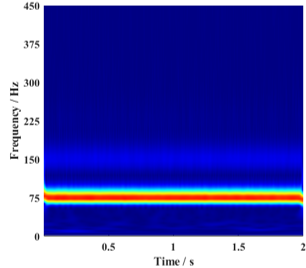
Compared with Fourier transform, CWT is more suitable for analyzing signals whose frequency content changes over time. For example, in pressure fluctuation analysis, transient frequency components can be clearly identified in both time and frequency domains.
8. Basic Procedure of CWT Analysis
The general procedure for applying CWT is as follows:
- Acquire the signal and determine the sampling frequency
- Choose an appropriate mother wavelet (e.g., Morlet, Mexican Hat)
- Define the scale range
- Compute the wavelet coefficients
- Convert scale to frequency if needed
- Plot the time–frequency representation (scalogram)
9. Common Mother Wavelet
One of the most commonly used wavelets is the Morlet wavelet, defined as:
It consists of:
- A complex exponential (oscillation)
- A Gaussian envelope (localization)
This makes it highly suitable for analyzing oscillatory signals.
10. Summary
The Continuous Wavelet Transform is a powerful tool for time–frequency analysis of non-stationary signals. Its core formula is:
The scale parameter controls frequency, the translation parameter controls time, and the wavelet coefficients represent the similarity between the signal and the wavelet.
CWT is particularly effective for analyzing transient phenomena such as shock signals, rotating stall, cavitation, vortex shedding, and pressure pulsations in complex flow systems.